


History Says AMD Stock's $1 Trillion Milestone Isn't a Ceiling
History Says AMD Stock's $1 Trillion Milestone Isn't a Ceiling

Daniel Sparks, The Motley FoolThu, October 1, 2026 at 6:01 AM UTC
0
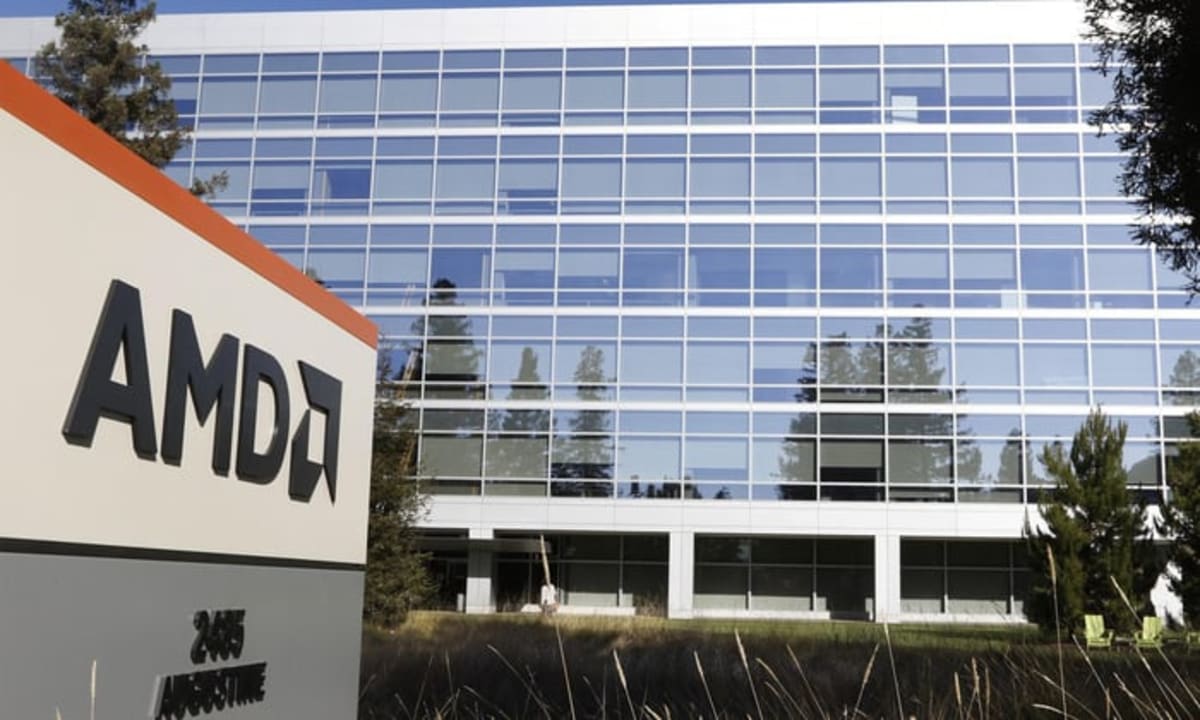
Image source: AMD.Key Points -
AMD closed with a market cap above $1 trillion for the first time on Sept. 21, 2026.
Nvidia, Taiwan Semiconductor, and Broadcom each gained in the 12 months after their first $1 trillion closes, by between 43% and 216%.
AMD's revenue climbed 50% year over year in the second quarter, and management forecast around 41% growth in the third quarter.
10 stocks we like better than Advanced Micro Devices ›
Advanced Micro Devices(NASDAQ:AMD) closed at $615.52 on Monday, Sept. 21, up about 10% for the day and worth over $1 trillion for the first time. It became the fourth U.S. chipmaker to hit the mark, after Nvidia(NASDAQ:NVDA), Broadcom(NASDAQ:AVGO), and Micron Technology.
The shares have eased a little since, to about $608, which still leaves AMD's value close to $1 trillion. Even so, the stock is up about 184% this year as of this writing.
Missed AI’s "Act 1"? Act 2 Could Be 15x Bigger. Most investors think they missed the AI boat because they didn't buy Nvidia in 2005. But according to our analysts, we’re only at the end of "Act 1"—the R&D phase. "Act 2" is the global rollout. Continue »
A round number doesn't change anything about a business. But several chipmakers crossed the same line before AMD, and three of them now have a full year of history on the other side of it.
Three for three
Nvidia first closed over $1 trillion in mid-June 2023, a couple of weeks after briefly clearing that mark during trading. Twelve months later, its shares were up around 216%.
Taiwan Semiconductor Manufacturing(NYSE:TSM), measured by its U.S.-listed shares, made it on Oct. 17, 2024, the day it posted a 36% jump in third-quarter revenue. A year later, the stock was up around 43%.
Broadcom crossed on Dec. 13, 2024, with a 24% one-day rise after its fiscal fourth-quarter report. Its shares ended the following 12 months up around 60%, even after an 11% fall on the last day of that stretch following its next fourth-quarter report.
Three memory makers joined the club by May 2026 -- Samsung Electronics, Micron, and SK Hynix. Their records are too recent to count yet, though Micron is up around 19% since its May 26 close as of this writing.
Of course, I wouldn't base a rule on three examples from one artificial intelligence (AI) spending boom. But $1 trillion wasn't a peak for any of them.
Growth mattered more than price
Interestingly, the stock that was cheapest relative to its sales at its crossing saw the smallest gain, and the priciest had the largest.
Taiwan Semiconductor traded at around 13 times trailing-12-month sales when it crossed. Its growth held up and even sped up a little, with third-quarter 2025 revenue climbing 41% year over year to $33.1 billion. The stock climbed by about as much.
Nvidia, though, cost almost 40 times trailing sales at its crossing. Its revenue for the quarter ended April 30, 2023, dropped 13% year over year. But management had just guided for $11 billion of revenue in the next quarter, and the growth that followed was extraordinary. A year later, Nvidia's quarterly revenue hit $26.0 billion, up 262% year over year.
Advertisement
Put another way, Nvidia's shares more than tripled in a year when its quarterly sales did, too.
Where does AMD fit?
AMD's own growth is strong. Its second-quarter revenue climbed 50% year over year to a record $11.5 billion, and growth has now accelerated for two straight quarters (34% in the last quarter of 2025, then 38% in this year's first quarter). The data center segment, which sells EPYC server processors and Instinct AI accelerators, led the way with revenue up 107% to $6.7 billion. But that gain compares with a year-ago quarter when data center sales had slipped. Measured against the fourth quarter of 2025 instead, segment revenue grew 25% over two quarters.
Management guided for third-quarter revenue of around $13 billion, up about 41% from a year ago. And CEO Lisa Su said during the company's August earnings call that she expects data center revenue to more than double in 2027.
At around 24 times trailing sales, AMD is cheaper than Nvidia was at its crossing but pricier than Broadcom (about 21 times sales) or Taiwan Semiconductor were at theirs. And going by analysts' 2027 estimates, AMD shares trade at about 39 times earnings.
To match Nvidia's year, I think AMD would need growth closer to Nvidia's. Even if data center revenue doubles in 2027, AMD's total revenue growth could be well below 262%. A year more like Taiwan Semiconductor's or Broadcom's arguably looks more realistic, and both started at lower sales multiples.
So far, $1 trillion hasn't been a ceiling for chipmakers, and I don't see why it has to be one for AMD. But the stocks that kept climbing had the growth to carry their prices. At around $608 a share, AMD's stock already assumes that data center doubling shows up on schedule. Three examples from one boom aren't enough for me to rely on that.
Should you buy stock in Advanced Micro Devices right now?
Before you buy stock in Advanced Micro Devices, consider this:
The Motley Fool Stock Advisor analyst team just identified what they believe are the 10 best stocks for investors to buy now… and Advanced Micro Devices wasn’t one of them. The 10 stocks that made the cut could produce monster returns in the coming years.
Consider when Netflix made this list on December 17, 2004... if you invested $1,000 at the time of our recommendation, you’d have $379,123!* Or when Nvidia made this list on April 15, 2005... if you invested $1,000 at the time of our recommendation, you’d have $1,396,103!*
Now, it’s worth noting Stock Advisor’s total average return is 933% — a market-crushing outperformance compared to 212% for the S&P 500. Don't miss the latest top 10 list, available with Stock Advisor, and join an investing community built by individual investors for individual investors.
See the 10 stocks »
*Stock Advisor returns as of October 1, 2026.
Daniel Sparks and his clients do not have positions in any of the stocks mentioned. The Motley Fool has positions in and recommends Advanced Micro Devices, Broadcom, Micron Technology, Nvidia, and Taiwan Semiconductor Manufacturing. The Motley Fool has a disclosure policy.
Source: “AOL Money”
